

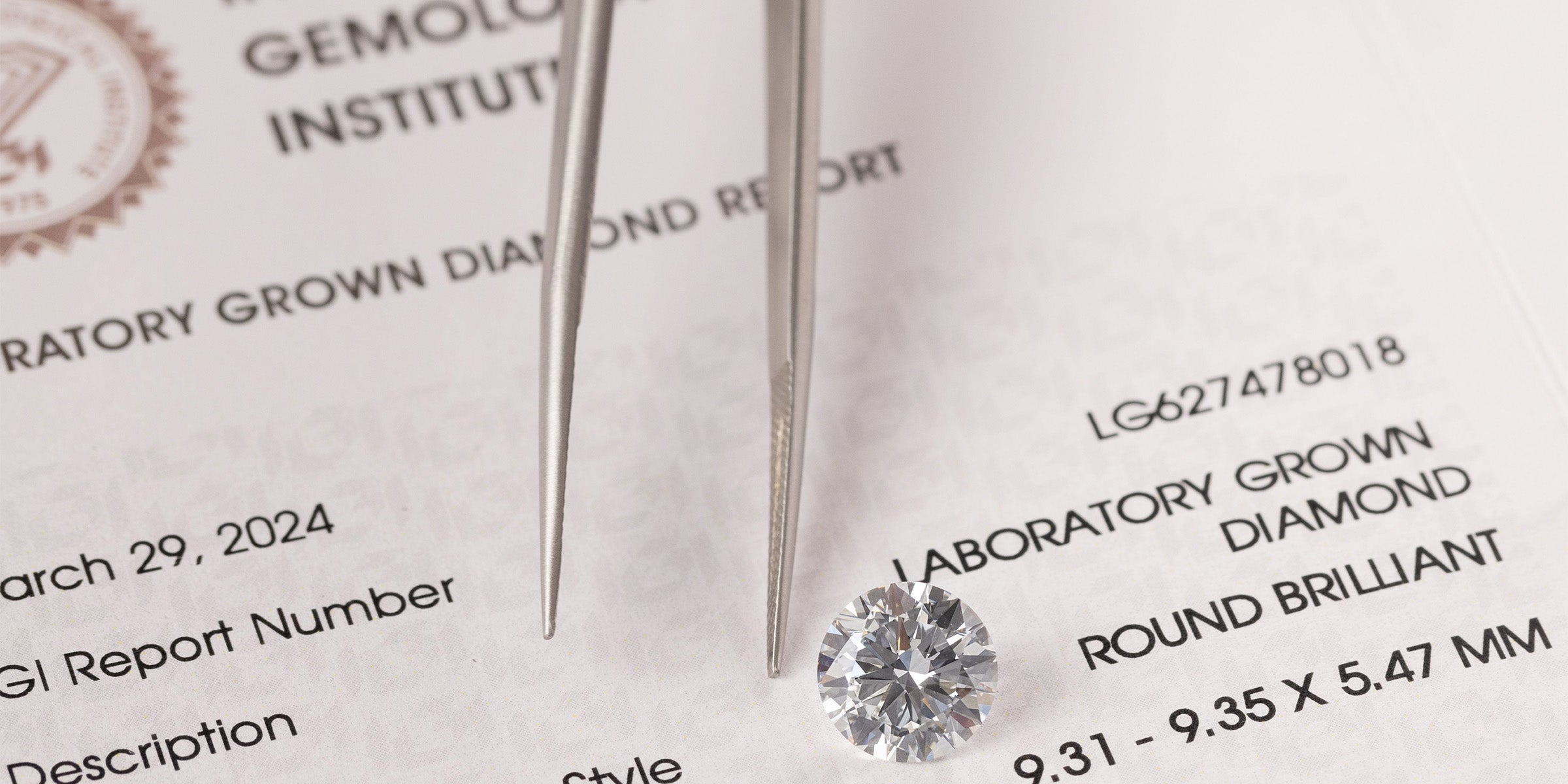
Understanding Diamond Certification
A diamond grading report provides an independent record of a diamond's characteristics, giving you a clearer understanding of the stone you are choosing.
It records details such as carat weight, colour, clarity, cut and measurements, and confirms whether a diamond is natural or lab-grown. For anyone buying a diamond, it is an important part of understanding exactly what they are purchasing.
But not all reports are identical, and the laboratory that issues one can also be part of the decision. So what does a diamond certificate actually tell you, and does it matter whether it comes from IGI, GIA or another recognised laboratory?
What is a diamond grading report?
A diamond grading report is an independent assessment of a diamond's characteristics by a professional gemological laboratory. It provides an objective record of the stone, rather than a description based solely on the seller's own assessment.
The report identifies the diamond and records important details such as its carat weight, colour, clarity, cut and measurements. It will also state whether the diamond is natural or lab-grown.
For the person buying the diamond, the report provides a useful point of reference. It allows you to understand the characteristics of the individual stone you are considering and gives you a record that can be checked against the diamond itself.
Why does certification matter?
A diamond grading report gives you an independent record of the stone you are buying. It allows you to see how the diamond has been assessed and understand its characteristics for yourself.
This can be particularly useful when comparing diamonds. Two stones may have the same carat weight, for example, but differ in colour, clarity, cut or proportions. A grading report allows you to see these details clearly and make a more informed comparison.
It also provides a record that belongs to the individual diamond. The report number can be checked against the issuing laboratory's records, helping to confirm that the report corresponds to the stone you are purchasing.
What does a diamond grading report tell you?
A diamond grading report records the characteristics that help describe and identify an individual diamond. The information included can vary slightly between laboratories, but a report will typically cover the key factors used to assess a diamond.
Carat weight: records the diamond's weight, measured in carats.
Colour: describes the diamond's body colour. For diamonds graded on the D–Z scale, D represents colourless, with the scale progressing towards more noticeable colour.
Clarity: records the presence of internal inclusions and external blemishes, and how they affect the diamond under the laboratory's grading conditions.
Cut: assesses how well a round brilliant diamond's proportions and facets interact with light. For other shapes, laboratories may record proportions and measurements without assigning the same overall cut grade.
Measurements: record the diamond's dimensions in millimetres, providing a further way to understand its physical size and proportions.
A report may also include a diagram, proportions information, fluorescence and other identifying characteristics, depending on the laboratory and the type of diamond being graded.
IGI vs GIA — what's the difference?
IGI (International Gemological Institute) and GIA (Gemological Institute of America) are both established gemological laboratories that assess diamonds and issue grading reports. Both can identify whether a diamond is natural or laboratory-grown and document characteristics such as carat weight, colour, clarity and measurements.
GIA has a particularly long-standing reputation in gemology and is widely recognised for its work in diamond grading and education. IGI also has a long history in diamond grading and has been grading laboratory-grown diamonds since 2005.
The reports themselves are not identical, and the terminology and format can differ between laboratories. For example, IGI's laboratory-grown diamond reports use the familiar D–Z colour scale and standard clarity grades, while GIA's current laboratory-grown diamond services use their own report format and terminology.
For this reason, it is less useful to think of one laboratory as simply being “better” than the other. What matters is that the diamond has been independently assessed by a recognised laboratory and that you understand what its report tells you.
Are lab-grown diamonds certified?
Yes. Lab-grown diamonds can be independently graded and issued with their own grading reports, just as natural diamonds can.
The report identifies the diamond as laboratory-grown and records its characteristics, including its carat weight, colour, clarity and measurements. Depending on the laboratory and the type of report, it may also include information about the diamond's cut, proportions and other identifying features.
At True Brilliance, our lab-grown diamonds are independently graded by IGI and supplied with an IGI grading report. This gives you an independent record of the individual diamond you are choosing.
How do I check a diamond's grading report?
An IGI grading report provides a record of the individual diamond, including its characteristics and identifying report number. The report number can be used to access the corresponding record with IGI, providing a further reference for the diamond and its grading.
When you receive your diamond, the details on the report will correspond to the individual stone, including its carat weight, measurements and other identifying characteristics.
What a grading report doesn't tell you
A grading report is an important part of understanding a diamond, but it does not tell you everything about how a diamond will look or whether it is the right choice for you.
Two diamonds can have similar grades on paper and still look different. Their proportions, facet arrangement and the way they interact with light all contribute to their appearance.
This is why a grading report should be considered alongside the diamond itself. The report gives you an objective record of its characteristics; the beauty of the individual stone is something that ultimately has to be appreciated as a whole.
The True Brilliance standard
At True Brilliance, every diamond we select is lab-grown and independently graded by IGI.
We believe certification should give you confidence in the diamond you are choosing, while our own selection standards allow us to focus on the qualities that matter to us when choosing each stone.
The result is a diamond with an independent record of its characteristics, selected to meet the standards we set for True Brilliance.